Put the Pressure Back on Your Opponent
When you’re playing Speed Wordz against another player, it’s easy to think of the Pass button as something you use only when you’re stuck.
I look at it a little differently.
A pass can be a strategic move.
Used at the right time, passing can give you a few more valuable seconds to study your letters and the board while putting the clock—and the pressure—right back on your opponent.
In a fast PvP game, that can make a big difference.
A Pass Doesn’t Have to Mean You’re Giving Up
Let’s say it’s your turn and you don’t immediately see a word.
You could spend your entire turn staring at your letters, hoping something appears.
Sometimes it will.
Sometimes the clock just keeps ticking while your letters sit there looking like they were chosen specifically to annoy you.
Instead, you can pass the turn back to your opponent.
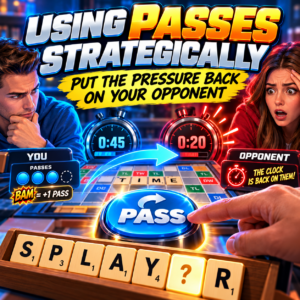
Now they’re on the clock again.
But here’s the important part:
You’re still thinking.
While your opponent is trying to make their next play, you’ve bought yourself additional time to study your rack, scan the board and look for your next move.
That’s what makes a pass potentially useful.
You Get 3 Passes — So Use Them Wisely
In Speed Wordz, each player starts with 3 passes per game.
That means passes are a limited resource. You don’t want to burn through all three simply because you didn’t see a word immediately.
Think of them as another tool in your strategy.
There is also a way to earn an extra one.
If you score a BAM, you’re awarded 1 bonus pass, giving you a maximum of 4 passes for that game.
But there’s an important catch:
The bonus pass is a one-time reward.
If you score another BAM later in the same game, you do not receive another pass. You can only earn that one additional bonus pass, for a total of four.
That makes earning a BAM even more valuable. Besides whatever else is happening on the board, you’ve just added another strategic option to your game.
And when the clock gets tight, that extra pass can come in very handy.
Put the Clock Back on Them
Speed Wordz is as much about managing time as it is about finding words.
When you pass, your opponent suddenly has another problem:
Do they already have another word ready?
Maybe they just used the play they had planned.
Maybe they expected to have your entire turn to study the board and prepare their next move.
Instead…
Pass.
They’re right back on the clock.
Now they’re the one who has to find something quickly.
Meanwhile, you’re getting another opportunity to think about your next move without your own timer running.
The Best Time to Pass
I wouldn’t recommend hitting Pass every time you don’t see a word in the first couple of seconds.
Remember, you’ve only got three passes to start with, or four if you’ve earned your one-time BAM bonus pass.
Use them strategically.
If you have a good play available, make the play.
But if you’re genuinely stuck and don’t see a strong option, ask yourself:
Would the rest of this turn be better spent searching, or would I benefit more by passing and continuing to think during my opponent’s turn?
That’s the decision.
A pass can be especially useful when you feel like you’re close to seeing something.
Maybe you’ve spotted a promising area of the board.
Maybe you know your letters can make something, but you haven’t quite put it together yet.
Passing can buy you another look at the problem while forcing your opponent to deal with theirs.
Use Your Opponent’s Turn as Thinking Time
This is probably the most important part of the strategy.
Don’t mentally check out after you pass.
Your opponent’s turn is now your preparation time.
Keep looking at your letters.
Scan different parts of the board.
Look for extensions.
Look for short words.
Look at prefixes and endings.
Think about what you can do with the letters you have.
And pay attention to what your opponent plays, because their move may create an opening that wasn’t available before.
Ideally, when the turn comes back to you, you’re not starting from zero.
You’ve already got an idea.
Even better, you’ve got a word ready to go.
The Pass Can Create a Little Mind Game
This is where PvP gets interesting.
Imagine your opponent just made a play.
They’re probably expecting you to take your turn while they start planning their next move.
Instead, you pass fairly quickly.
Suddenly they’re playing again.
That can disrupt their rhythm.
Now they have to decide:
“Wait…what am I playing next?”
That’s pressure.
And in a timed game, pressure matters.
You aren’t just trying to find words. You’re trying to find them while a clock is reminding you—rather enthusiastically—that you don’t have all day.
Don’t Wait Until the Last Second to Pass
If you’ve already decided that you’re probably going to pass, don’t automatically burn your entire clock first.
Think about what you’re gaining.
If you spend almost your entire turn struggling and then pass, you’ve given your opponent all that time to prepare their next move too.
Sometimes an earlier pass is more disruptive.
Your opponent may have expected another 20, 30 or 40 seconds to prepare.
Instead:
Surprise. Your turn again.
Now you’ve changed the rhythm of the game.
But Don’t Become Predictable
Like most strategies, passing works better when you don’t overuse it.
And because your passes are limited, there’s another reason not to throw them away.
If you constantly pass immediately whenever you’re stuck, an experienced opponent may begin expecting it.
And if they’re expecting it, they’ll start preparing accordingly.
Mix things up.
Sometimes take your time.
Sometimes make a quick play.
Sometimes pass.
You want your opponent wondering when they’re going to be back on the clock.
A Pass Can Also Give You Information
There’s another benefit that’s easy to overlook.
Your opponent has to make another move.
That move changes the board.
They may open a new lane, expose a useful letter, extend an existing word or create an opportunity you didn’t have before.
So while you’re thinking during their turn, you’re not necessarily waiting for the same board to come back.
You may get new possibilities.
Of course, your opponent might also take away the opening you were considering.
That’s part of the gamble.
Don’t Pass Just to Pass
There’s an important difference between strategic passing and simply avoiding your turn.
If you’ve already found a strong word, don’t get too clever.
Play it.
A pass is most useful when it solves an actual problem: you don’t have a good move ready, you’d benefit from more thinking time, and you can put immediate time pressure back on your opponent.
With only 3 regular passes per game, every pass should have a reason behind it.
And if you’ve earned that fourth pass with a BAM, don’t forget you’ve got it. That extra pass might be exactly what you need later in the game.
The goal isn’t to pass more.
The goal is to make your passes useful.
Think of Passes as Part of Your Time Strategy
This is the bigger lesson.
In Speed Wordz, your opponent’s clock can be useful to you too.
When you pass, you’re essentially saying:
“I don’t have my move yet, so you figure out yours while I keep working on mine.”
That’s very different from thinking:
“I couldn’t find a word, so I lost my turn.”
Used properly, a pass can give you additional time to find your next word, put immediate pressure back on your opponent, interrupt their preparation and rhythm, give you a chance to see how their next play changes the board, and help you avoid wasting an entire turn searching for a word that isn’t coming together.
Just remember: you start with 3 passes. Earn a BAM and you can get 1 bonus pass for a maximum of 4—but only once per game.
So don’t think of the Pass button as a white flag.
Sometimes it’s more like handing your opponent a ticking clock and saying:
“Here. You deal with this for a minute.”
Then get back to work finding your next word.
Ready to put these strategies to work?