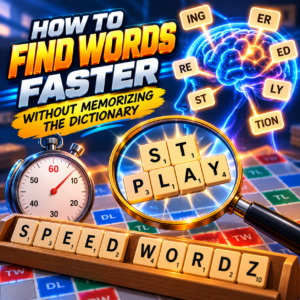
How to Find Words Faster Without Memorizing the Dictionary
One of the questions behind almost every word game is:
How do some people see words so quickly?
It can look like they have a dictionary installed in their head.
Usually, they don’t.
What experienced players develop is pattern recognition.
Instead of examining seven unrelated letters individually, their brain starts recognizing combinations that commonly appear together.
You can train yourself to do the same thing.
Stop reading your rack from left to right
If your letters are:
R A T E S L P
your brain may keep reading them in exactly that order.
Mix them up mentally.
Look for combinations.
ST, ER, PL, AR, ATE…
Changing the order can make a word suddenly jump out at you.
If Speed Wordz gives you the ability to shuffle your rack, use it when you’re stuck. Sometimes your brain just needs the letters rearranged.
Look for word endings
Common endings are extremely useful.
For example:
-S
-ED
-ER
-ING
-LY
If you see the letters for a familiar ending, mentally separate them and examine what’s left.
Instead of solving seven letters, you may suddenly be solving four or five.
Look for beginnings too
The same idea works at the front of words.
Recognizing familiar beginnings can quickly narrow the possibilities.
You’re essentially breaking one large problem into smaller ones.
Use the board as a clue
This is one of the biggest mistakes newer players make.
They try to create a complete word from their rack first and then figure out where it belongs.
Reverse the process.
Find an opening on the board.
Now ask:
What word can I build here?
The existing board letters become clues.
That’s much easier than searching through every possible word your rack could theoretically create.
Learn families of words
When you encounter a useful word, don’t just remember that single word.
Think about related forms.
Can it take an S?
Can you add ED?
Can it become another form with ER or ING?
One word can teach you several future plays.
Practice seeing small words
Long words are memorable, but short words keep games moving.
Get comfortable recognizing useful short combinations quickly.
They can get you out of difficult racks, connect to crowded parts of the board and create opportunities for later turns.
Give your brain repetitions
There really isn’t a substitute for playing.
The more often you see letter combinations, board patterns and word structures, the faster your brain recognizes them.
Eventually you’ll see a group of letters and a word will appear almost immediately.
That’s not magic.
That’s your brain saying:
“Oh, I’ve seen this mess before.”
And in Speed Wordz, that recognition can save several very valuable seconds.
Ready to put these strategies to work?