How I Recommend Practicing Against Speedie AI
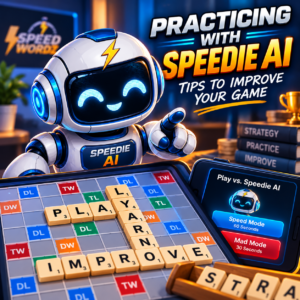
Speedie AI isn’t just there for times when you don’t have another person available.
It can also be a useful practice partner.
The advantage of practicing against an AI opponent is simple: you can focus on improving a specific part of your game without worrying about another person’s schedule.
Here are a few ways I’d use it.
Practice board scanning
For several games, make this your only goal:
Before looking deeply at your rack, scan the entire board.
You’re training a habit.
Don’t worry about whether every move is brilliant. Concentrate on finding openings quickly.
After several games, you’ll start doing it automatically.
Practice finding a backup word
Try to find one playable word as early as possible during every turn.
Don’t necessarily play it immediately.
Remember it, then look for something better.
This is excellent preparation for timed competition because it prevents the dreaded:
5…4…3… WHERE DID MY WORD GO?!
moment.
We’ve all been there.
Practice using more of the board
Try deliberately playing in areas you normally overlook.
This teaches you to stop following the previous move around the board.
Sometimes you’ll discover opportunities that you wouldn’t normally consider.
Alternate Speed and Mad Mode
Use Speed Mode when you want to study your decisions.
Give yourself time to ask:
Was there another opening? Could I have extended something? Did I overlook an easier play?
Then switch to Mad Mode and try to make those same decisions faster.
You’re training accuracy first and speed second.
Don’t judge improvement by wins alone
Winning is fun. Obviously.
But if you’re practicing, look at other signs of progress.
Are you finding playable words sooner?
Are you using more of the board?
Are you getting stuck less often?
Are you staying calmer when the timer gets low?
Those are meaningful improvements.
Experiment
AI practice is a great place to try something different.
Use a strategy you normally avoid. Take a chance on a different part of the board. Practice preserving certain letters. Try finding two possible plays before choosing one.
Some experiments will work.
Some will be terrible.
That’s why it’s practice.
The goal isn’t to play one perfect game. The goal is to make the things you learn show up naturally when you’re playing a real opponent.
Ready to put these strategies to work?